

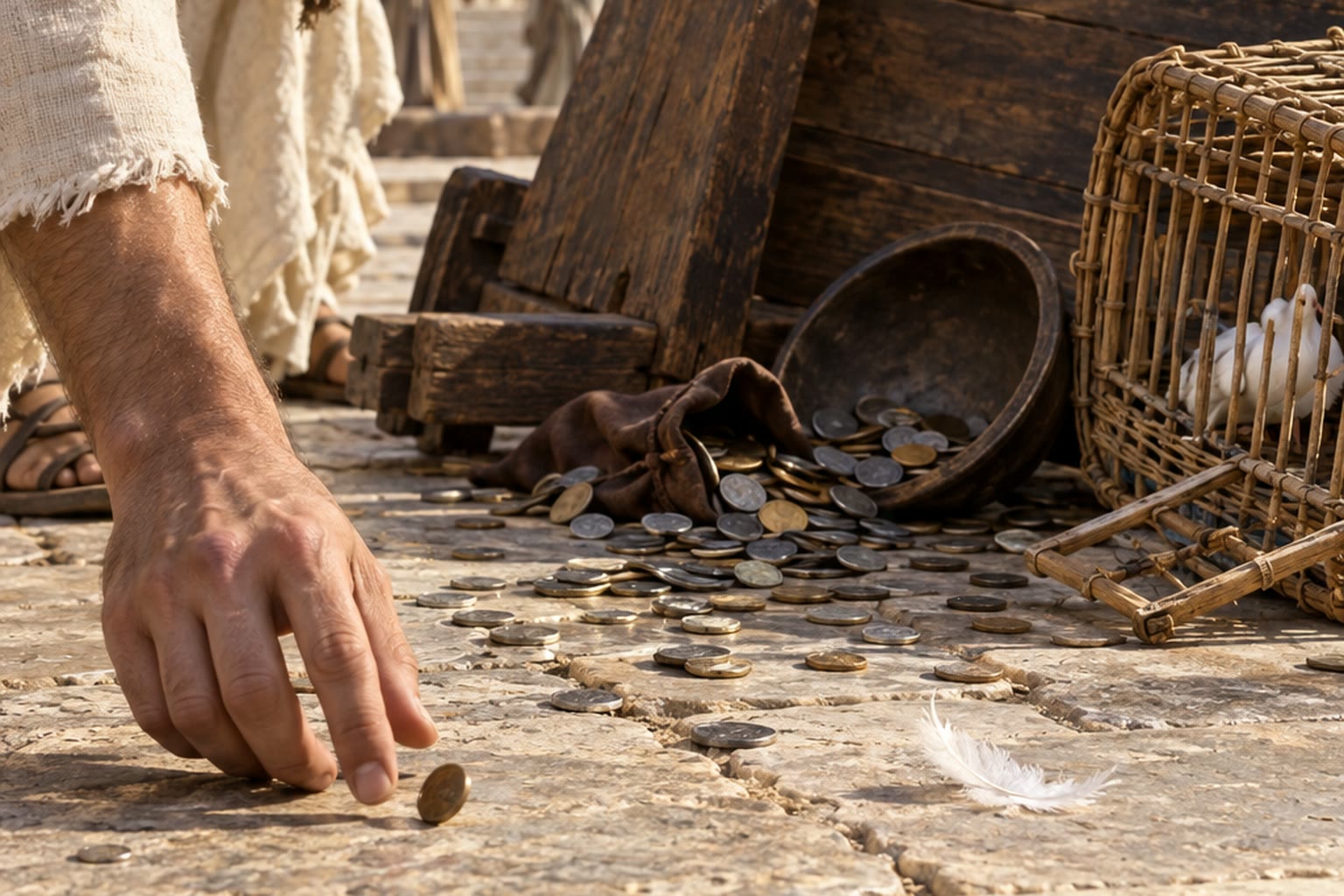
And he taught, saying unto them, Is it not written, My house shall be called of all nations the house of prayer? but ye have made it a den of thieves. -- Mark 11:17 (KJV)
Mark splits the fig tree story in two and sets the temple between the halves. Jesus finds a tree with "nothing but leaves." He walks into the temple and overthrows "the tables of the moneychangers, and the seats of them that sold doves." The next morning the tree is dead from the roots. Mark does the same in chapter 5, where the woman who "touched his garment" interrupts the story of Jairus's daughter.
He Looked Round About
Only Mark records that Jesus looked the temple over on the evening He arrived. He went in, "and when he had looked round about upon all things," He returned to Bethany for the night. The next morning He walked up to a fig tree the same way, looking for fruit, and found leaves.
With Passover days away, the temple looked like the most fruitful tree in Israel, its courts crowded and its trade brisk. Through Hosea the LORD remembered Israel's fathers as "the firstripe in the fig tree at her first time." Through Jeremiah He warned of a day with "no grapes on the vine, nor figs on the fig tree."
Room for the Nations
Jesus quoted Isaiah 56, a chapter that promises "the sons of the stranger" a welcome on God's holy mountain: "mine house shall be called an house of prayer for all people." The money tables stood in the outer court, the only part of the temple a Gentile could enter. A low stone barrier warned Gentiles to go no farther, on pain of death. The traders bought and sold in the outsiders' court.
Paul later told Gentile believers that Jesus "hath broken down the middle wall of partition between us." The house of prayer for all people stands open, and a church can crowd its own doorway with busyness.
Think of someone who would feel out of place in your church on Sunday. What would it take to make room for that person to pray beside you?

